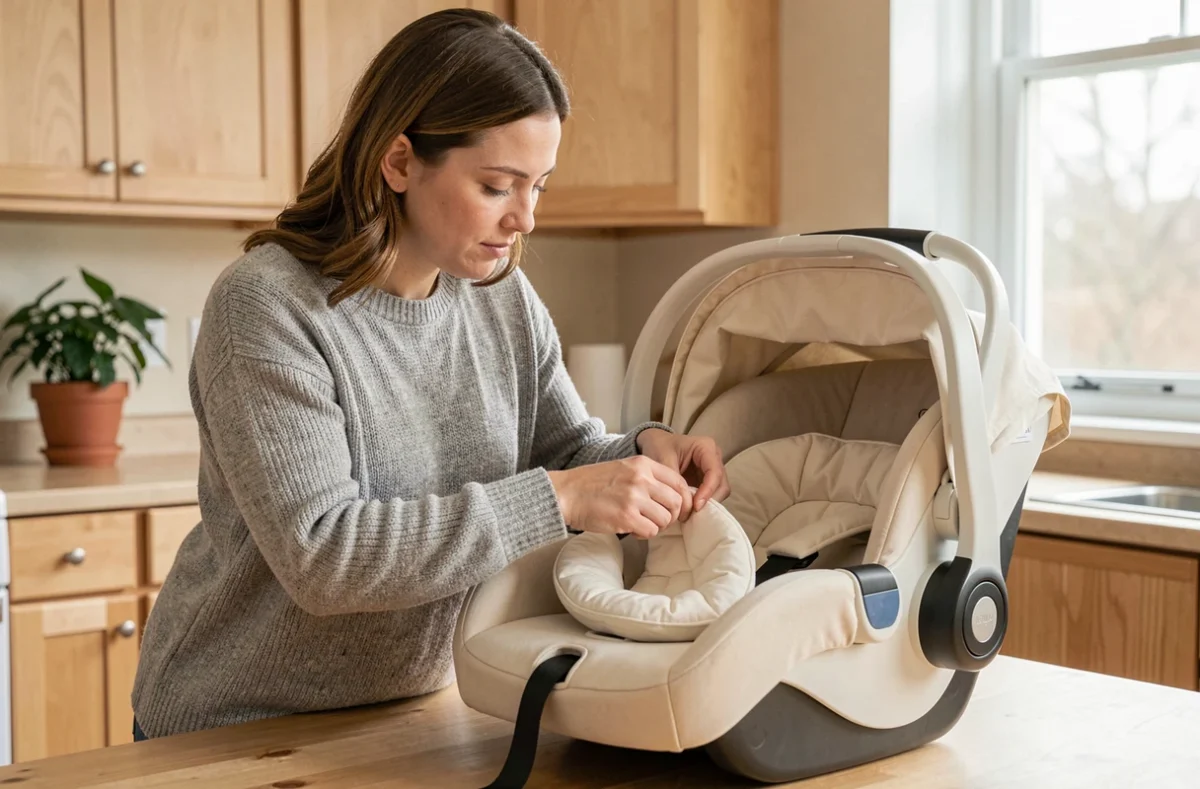
The reducer delivered with a baby car seat serves a specific function: to fill the space between a newborn’s body and the car seat shell to keep their head, back, and hips aligned. Knowing when to remove it depends less on a theoretical age than on morphological criteria specific to each child and the manufacturer’s instructions.
Understanding these criteria helps avoid two symmetrical mistakes: keeping the reducer for too long (discomfort, overheating, improper harness fit) or removing it too early (insufficient support for the head and neck).
Criteria for removing the baby seat reducer: comparison of common benchmarks
Several benchmarks circulate among parents, forums, and manuals. Not all are equally valid. The table below compares them to clarify what constitutes reliable recommendations and what remains approximate.
| Benchmark | Source | Reliability |
|---|---|---|
| Age (approximately 3-4 months) | Forums, word of mouth | Low: growth varies significantly from one baby to another |
| Weight indicated in the manual | Seat manufacturer | High: the seat is tested and approved with these thresholds |
| Height (torso length and head position) | Manufacturer, R129 standard | High: exceeding the shell is measured visually |
| Comfort perceived by the baby (crying, sweating) | Parental observation | Useful signal, but should be cross-checked with the manufacturer’s criteria |
The most reliable information remains that printed in the manual and on the car seat label. Texas Children’s Hospital recommends checking the weight and height limits indicated by the manufacturer and using only the accessories provided or approved with the seat.
To delve deeper into the recommended age for removing the reducer, it is essential to always relate general benchmarks to the specific model you are using.

Manufacturer’s instructions vs. general rule: why the instructions prevail
A Cybex, Maxi-Cosi, or Joie car seat does not use the same insert. Some reducers only cover the seat, while others include a removable headrest and a back cushion. The removal threshold varies from model to model, sometimes by several kilos or centimeters.
The R129 (i-Size) standard requires that the seat be approved according to the child’s height, not just their weight. With this standard, the child must travel rear-facing until at least 15 months. Some seats also impose a minimum height threshold before any change in orientation.
Removing the reducer and switching to forward-facing are two distinct decisions. Confusing the two may lead to turning the seat too early, which increases strain on the neck in the event of sudden braking.
Third-party accessories: an underestimated risk
Adding a separately purchased reducer cushion, even if it seems to improve support, can compromise safety. According to Safe in the Seat, an accessory not tested with the seat can alter the baby’s position and the harness trajectory in the event of a collision. The rule is simple: only the elements provided with the car seat or explicitly approved by the manufacturer should be used.
Concrete signs to observe on the baby in the car seat
Beyond the weight and height noted in the manual, certain physical indicators signal that the reducer should be removed. Here they are:
- The baby’s shoulders exceed the lateral edges of the reducer, preventing the harness from passing correctly through the designated slots.
- The top of the baby’s head reaches the upper edge of the shell, indicating that the integrated headrest in the reducer no longer serves its purpose.
- The baby sweats abnormally or shows repeated discomfort as soon as they are installed, even when the ambient temperature is normal.
- The harness, even adjusted to the tightest notch compatible with the reducer, leaves slack at the shoulders or hips.
A poorly adjusted harness negates the seat’s protection, regardless of the reducer. After removal, check that the straps pass through the slots corresponding to the child’s size and that you can slide one finger, no more, between the strap and the collarbone.

Thick clothing and reducer: a combination to avoid in winter
In cold weather, a baby dressed in a snowsuit or thick coat takes up more volume in the shell. The reducer combined with bulky clothing compresses the torso and prevents the harness from fitting properly against the body.
The best practice is to dress the baby in thin layers (bodysuit, pajamas, or light fleece), adjust the harness, and then place a blanket over the straps. This method avoids distorting the reducer’s fit while keeping the baby warm.
Partial removal according to the seasons
Some manufacturers offer a two-part reducer (seat and headrest). Removing the seat while keeping the headrest can be a relevant intermediate step when the baby grows in torso length but still has a small head relative to the shell. Again, this option is only valid if the model’s manual explicitly allows it.
The reducer of the car seat does not have a fixed expiration date: it is removed when the child’s morphology, combined with the manual thresholds, requires it. Keeping the habit of checking the harness fit at each installation remains the most reliable safety gesture on a daily basis, with or without the reducer.