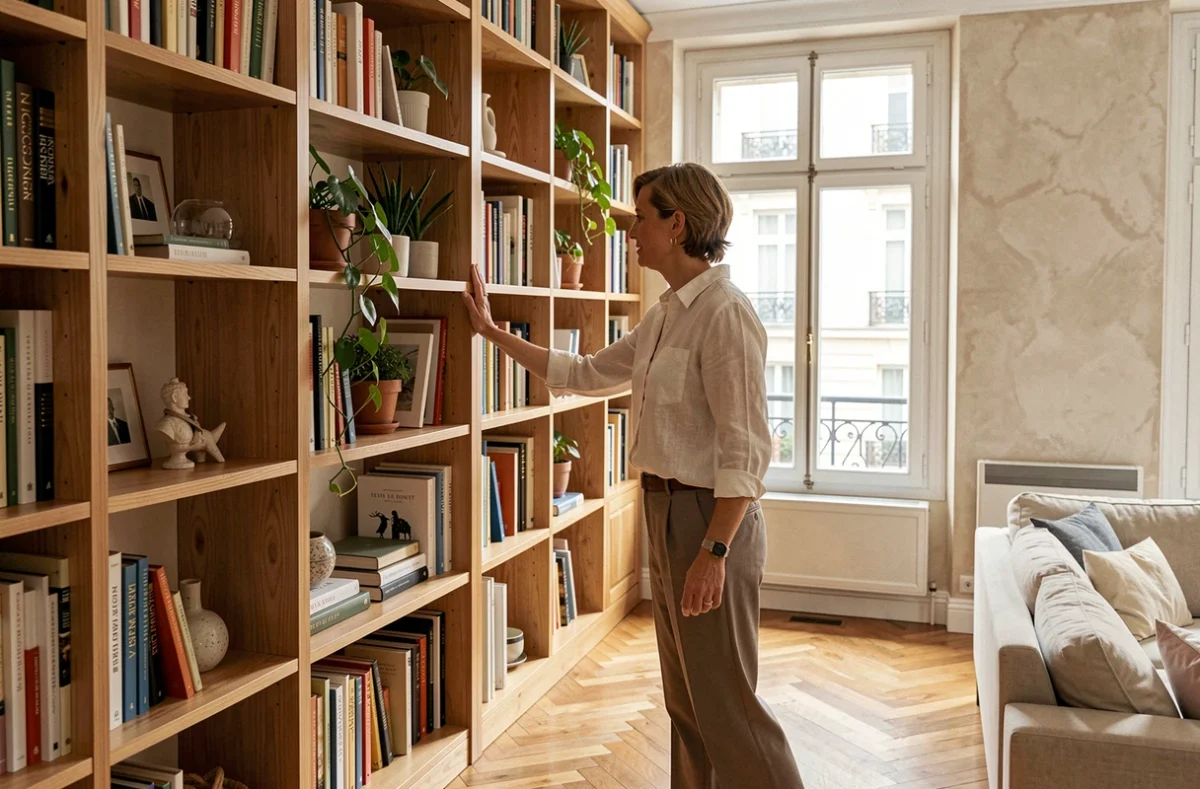
A corridor too narrow to accommodate a standard piece of furniture, an L-shaped kitchen where every centimeter counts, a living room that loses intimacy: custom design almost always starts with an architectural constraint that no catalog can solve. Rather than forcing a piece of furniture into a space that doesn’t suit it, custom design begins with the actual volume to create a tailored solution from floor to ceiling.
Architectural Constraints and Custom Furniture: Starting from the Wall, Not the Catalog
We often encounter the same scenario: a recess a few centimeters too deep for a standard closet, or a sloping ceiling whose angle makes any prefabricated shelf unusable beyond the first level. In these cases, custom design transforms the constraint into usable storage.
A carpenter or designer takes measurements directly on-site, including the imperfections of the structure (walls not square, out of plumb). The result: a piece of furniture that fits the actual geometry of the room. No gap between the side panel and the wall, no wasted space above the unit.
The situations where this approach makes a difference are specific. We think of the slopes of converted attics, niches created by chimney flues, or long entryways where an integrated wardrobe frees up passage. Professionals specialized in this field, like those found on interieur-concepts.be, design layouts that precisely address these types of issues.
The common pitfall: ordering “semi-custom” (adjustable dimensions within a predefined range) thinking it will yield the same result. Feedback varies on this point, but as soon as the angle of the wall exceeds two or three degrees off square, semi-custom leaves dead spaces that only a millimeter-perfect job can correct.
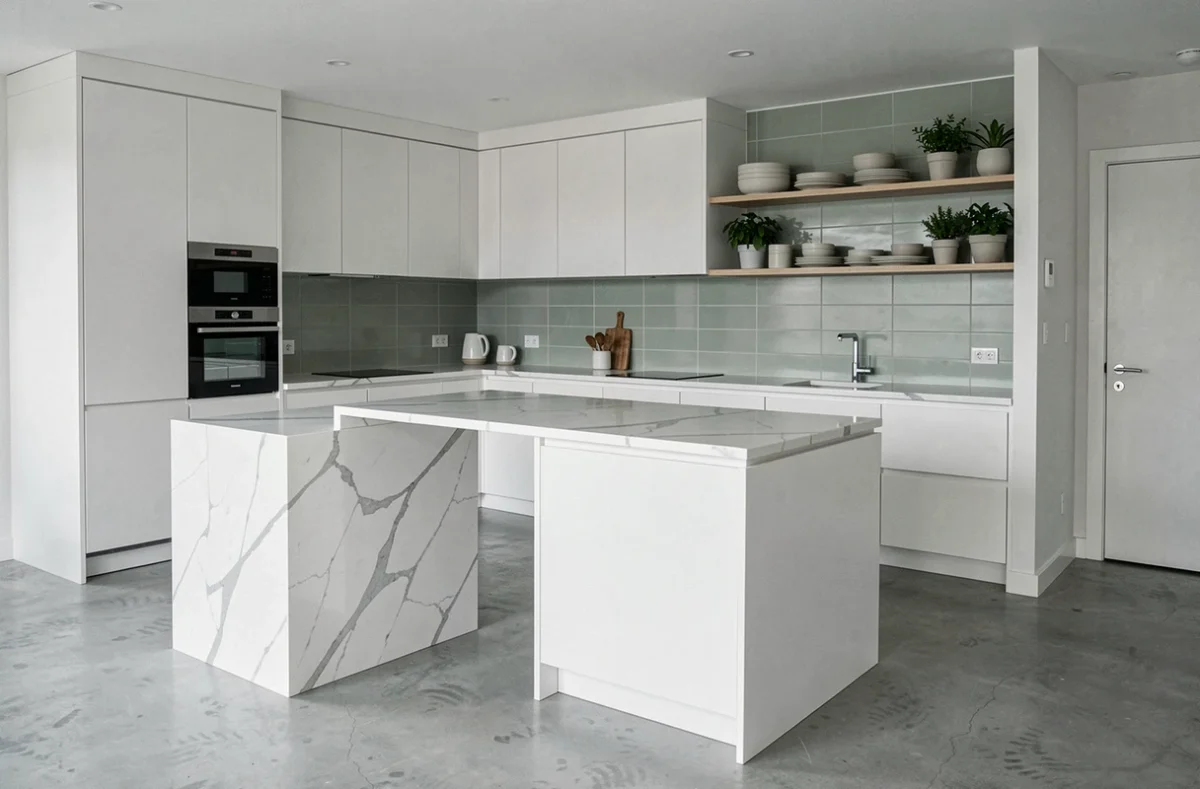
Custom Kitchen and Bathroom: Technical Spaces Where Standard Costs More
The kitchen alone accounts for the majority of requests for personalized design, and for a simple reason: it is the room where the distance between the countertop, sink, and cooking area determines daily comfort. A few centimeters difference in the depth of a lower cabinet alters the flow throughout the room.
In the bathroom, the logic is the same. A standard 60 cm wide vanity rarely fits the available space between the shower and the wall. A bathroom cabinet designed to exact dimensions frees up passage and allows for storage integration where an industrial model would leave unnecessary voids.
What Really Justifies the Extra Cost in These Rooms
Custom design in kitchens and bathrooms is not just about size. It also involves choosing materials suitable for humidity and thermal constraints. A custom-cut countertop in a heat-resistant composite material will last significantly longer than a countertop cut roughly in-store.
- The kitchen cabinet adjusted to the centimeter avoids fillers (filling panels) that weaken the whole and accumulate dust.
- Interior drawers sized for actual contents (pots, spices, cleaning products) eliminate the need for added organizers.
- The electrical layout can be planned within the furniture itself, with integrated cable passages, simplifying renovation.
Budget for Custom Design: Anticipating Real Costs
The classic reflex is to compare the price of a custom piece of furniture to that of a flat-pack piece. This comparison overlooks several factors. A custom design includes measuring, technical design, and installation, three steps absent from the price displayed in large retail stores.
In return, savings are made on subsequent adjustments. No need to buy a side panel, have a countertop resized, or pay for a second trip to correct an adjustment defect. The overall cost, once these adjustments are accounted for, reduces the gap between the two options.
Materials as a Variable for Project Adjustment
The budget largely depends on the choice of materials. A melamine layout remains affordable and sufficient for a dressing room or pantry. Solid wood or oak veneer increases the price but also the durability and aesthetic appeal.
Prioritizing custom design where the constraint is real allows for better control over the overall budget. One invests in a TV unit built into a complex niche, and chooses standard furniture for rooms with common dimensions. This distribution is often the most cost-effective.

European Regulation and Sustainability of Custom Furniture
The European regulation on the eco-design of sustainable products (ESPR, regulation (EU) 2024/1781), which came into effect on July 18, 2024, will gradually affect the furniture category. A specific delegated act for furniture is expected around 2028. Every piece of furniture sold must be able to be disassembled, repaired, and documented via a digital product passport.
For custom design, this evolution has a direct consequence: artisans and designers will need to provide traceability of the materials used, their origin, and end-of-life options. Projects designed now with removable assemblies (screws and dowels rather than irreversible glue) will be ahead of these requirements.
- Certified wood-based panels (PEFC, FSC) already partially meet the expected recyclability criteria.
- Removable hardware (snap-on hinges, glue-free assembly systems) facilitate future repairs.
- The technical documentation provided by the artisan (plans, component lists) will form the basis of the required digital passport.
Having a custom design done today while considering these criteria ensures that the furniture will remain compliant with upcoming European standards, without costly interventions later. A well-designed and well-documented piece of furniture can be repaired, resold, or recycled, whereas a glued flat-pack piece ends up in the landfill.